

By GoCaldas Team●25 May 2020
Running the Thermal Hospital, Leading the Town Council and Dreaming of a European Spa: Rodrigo Berquó, the Man of the Waters
Between 1888 and 1896, the architect Rodrigo Berquó set out to make Caldas a spa town to rival the best in Europe. Meet the visionary who transformed the thermal complex and Parque D. Carlos I.


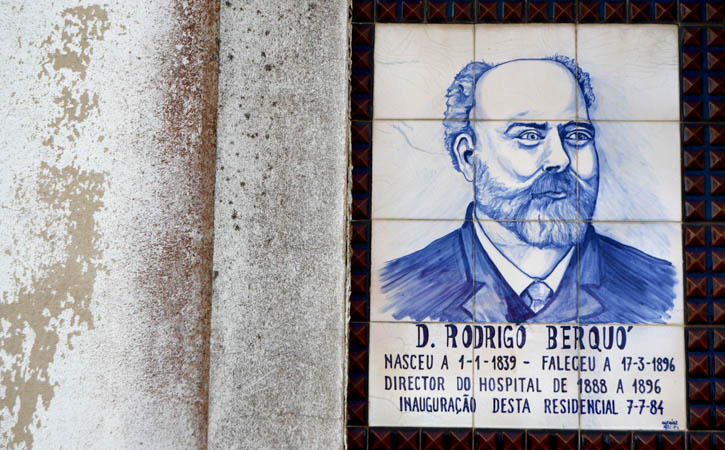
Rodrigo Berquó, the man of the waters: the man behind the Thermal Hospital dream.
Rodrigo Berquó, the visionary of Caldas da Rainha


One of the most important contributions to the history of Caldas da Rainha came from Rodrigo Maria Berquó (1839–1896). He was administrator of the Thermal Hospital from 1888 to 1896, which earned him the name “the man of the waters”, and mayor of the town from 1890 to 1891.
Berquó was born on 1 January 1839. His mother was Maria Teresa Caldas (a sign of things to come?) and his father João Maria Berquó, Marquis of Cantagalo, a title granted by Emperor Pedro I of Brazil that Rodrigo would later inherit. He also had seven brothers and sisters.
It is not known for sure whether he was born in Brazil or in Portugal, as his father was part of the court of King João VI that moved to Brazil and later served Pedro I of Brazil.
Rodrigo Berquó’s background

He trained in architecture and engineering, and it was this training that brought him to Caldas.
Berquó moved in the circles of the Portuguese elite, in places such as Cascais, Caldas da Rainha and Sintra. There he enjoyed bullfighting, a long tradition in Caldas, music, always an important part of any celebration, and shooting, which would become part of the leisure programme in Caldas in the years that followed.
His love of sport earned him the label of “sportsman”, a fashionable term at the time for those who stood out for their athletic skills.
Berquó was also known as a fine host and good company, something people noticed during his stays in Caldas both before and after he became administrator of the hospital.
He was, without doubt, a man of many talents!
Rodrigo Berquó, the man of the waters

He was appointed administrator of the Thermal Hospital to carry out the Improvement Plan approved in 1884, which aimed to modernise the spa complex and overcome its shortcomings. Spas were in fashion and attracting more and more people, and Caldas da Rainha was one of the best examples in Portugal, if not the best: the “Queen of Spas”, as it was called at the time.
For the first time in the hospital’s history, its administrator was not a doctor but an architect, who already had experience running a spa at Caldas da Felgueira, in the district of Viseu, from 1882 to 1888.
His ideas and determination led him to draw up an even more ambitious plan, which met with opposition, largely because of the rivalry between the two local powers: the Thermal Hospital and the Town Council. Ever practical, he successfully ran for mayor and managed both institutions for a year.
In the eight years he worked in Caldas, Berquó renovated the whole thermal complex: the Thermal Hospital, the woodland, the Park Pavilions, Parque D. Carlos I, the Clube de Recreio, the Royal Palace (now the Hospital and Caldas Museum), the convalescent home and the administrators’ house. He modernised and expanded it, making it more efficient, practical and attractive.
The works of Rodrigo Berquó
But he did not stop at the spa. His work reached other parts of the town, including the street that runs around the hospital, which is now named after him.
At a time when hygiene and public health were a major concern, he also took steps to improve sanitation in what was then still the village of Caldas da Rainha. He designed the Santo Isidoro Hospital (opened in 1893, now part of the ESAD.CR art school) and the slaughterhouse (opened in 1894, now the Youth Centre), and improved the sewage system and drinking water supply.
Other projects, such as a new bullring and a theatre, never went ahead, either for financial reasons or because he could not win the support of the local elite.
All these measures aimed to put Caldas da Rainha on a par with the most prestigious spa resorts in Europe, some of which Berquó had visited himself.
He was also a generous philanthropist. He donated money and equipment to the hospital and invested in training its staff, for whom he set up a school, going well beyond the job that had brought him to the town.
Sociable by nature, he also livened up local society. He was a baritone, a clarinettist and an actor, took an active part in local entertainment and sometimes invited distinguished friends to add to the town’s festivities.
Recommended guided tour
Best of Caldas da Rainha with a local guide
Discover the historic centre, the Thermal Hospital and Praça da Fruta with a local guide.
A royal friend and a thorn named Bordalo
His work was recognised by King Carlos, who made him an Officer of the Order of Saint James in 1892 and a Commander of the same order the following year.
However, his determination and strong convictions drew criticism from the local community, especially the elite. He was satirised many times by Rafael Bordalo Pinheiro, who, among other jibes, nicknamed him “Moses of the Fresh Waters” over the water supply for the park lake.
Despite the criticism, and although his work was left unfinished by his early death in 1896, Berquó’s ideas helped make Caldas a spa town that could stand alongside the most prestigious ones abroad.
He withstood, not without difficulty, all the pressure and criticism, and tried to make Caldas da Rainha one of Portugal’s main spa towns, well planned and full of things to do.
In the years that followed, his legacy was most visible in Parque D. Carlos I, which became the heart of the resort’s leisure and social life. His other great project, the Park Pavilions, never fulfilled its purpose, as the buildings were never used for what they were designed for.
On the centenary of his death, in 1996, a tribute exhibition was held and a plaque was placed in Parque D. Carlos I in honour of one of the most important figures in our history. Come and get to know him better with GoCaldas.
Frequently Asked Questions
Who was Rodrigo Berquó?
An architect and engineer (1839–1896), administrator of the Thermal Hospital from 1888 to 1896 and mayor of Caldas da Rainha from 1890 to 1891.
What did Rodrigo Berquó build in Caldas da Rainha?
He renovated the whole thermal complex, including the Thermal Hospital, the woodland, Parque D. Carlos I and the Royal Palace, and designed the Santo Isidoro Hospital (1893) and the slaughterhouse (1894). The Park Pavilions were his great unfinished project.
Is there a tribute to Rodrigo Berquó?
Yes. A plaque was placed in Parque D. Carlos I on the centenary of his death, in 1996, and the street around the Thermal Hospital bears his name.
More history of Caldas da Rainha
- Queen Leonor, the founder
- King Carlos I and Caldas da Rainha
- José Malhoa, the naturalist painter
- Rafael Bordalo Pinheiro in Caldas da Rainha
- Francisco Grandella and Foz do Arelho
- Caldas da Rainha ceramics
This article was put together by the GoCaldas team, the local travel guide to Caldas da Rainha.